
Summary
- BBBY is trading above book value again, whereas in April it had traded near 30% of its book value.
- Bonds have recovered since April, but the 2034 and 2044 maturities are still continuing on the general downtrend established in 2016.
- Long-term prosperity will likely come from capital outlays to increase digital footprints, while physical expansion is another possibility.
While shares of Bed Bath & Beyond (BBBY) have performed remarkably well since April, up over 250%, the long term signals that its bonds were flashing still remain. Even though Bed Bath & Beyond is working to revitalize its digital side, it doesn't seem to have the necessary capital structure to keep itself afloat in the long-term swing of things.
When I last covered Bed Bath & Beyond on April 1 (read here), it was quite hard to see how the retail environment would transform. Bed Bath & Beyond closed over 1,300 stores, but was committed to keeping its Harmon and buybuyBaby stores open to provide infant essentials. CEO Mark Tritton acknowledged that Bed Bath & Beyond was in a financially stable position with over $1.4 billion in cash and access to credit facilities.
Back then, Bed Bath & Beyond looked promising from a short-term recovery standpoint when it had been floating around $4 per share, since it was trading at a P/B of ~.30. So, while the whole retail industry was still reeling from immediate shocks (closures) and bankruptcy fears were heightened, Bed Bath & Beyond, like many retailers, was trading far below its book.
Now, Bed Bath & Beyond is trading at a P/B of ~1.07, per its book value of $11.75 calculated from its most recent quarterly results. It's a bit troublesome that while the business dynamic has shifted from in-store to online, Bed Bath & Beyond is pushing towards valuations on a P/B standpoint it last saw in late 2019, and early 2018 when it had been posting quarterly profits.
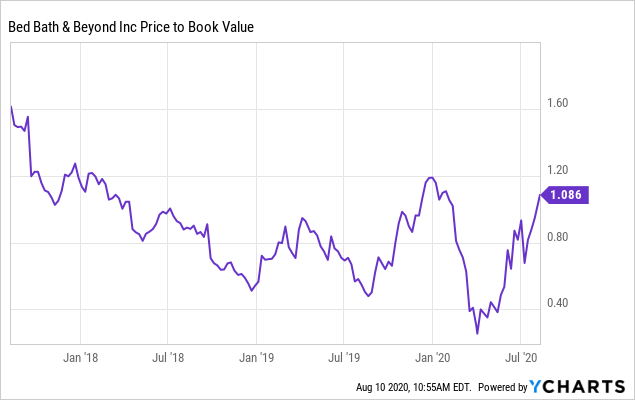 Data by YCharts
While Bed Bath & Beyond looks less appealing from its P/B than it had in April, its bonds still show a promising outlook. Bed Bath & Beyond has posted six straight quarters of net losses, variable cash flows, and $250 million more debt added during last quarter, which could make its access to credit harder in the long term.

