
Summary
- Continuing the series of presenting high-quality SWAN stocks to our readers, Church and Dwight (CHD) has made it to the list.
- Sceptisists argue that its acquisitions haven't been properly integrated into its existing business model and that there is a lack of future visibility and strategy execution.
- In my opinion, CHD should be seen as a consumer staples conglomerate acquiring #1 brands that are already reliable cash cows.
- By combining 3% annual organic growth from the existing business, 10% growth from EBITDA margin expansion over the next 3 years, 1.5% reduction in its share count and a starting FCF yield of 4.1%, there's a decent buying opportunity.
Executive Summary
Continuing the series of presenting high-quality SWAN stocks to our readers, Church and Dwight (CHD) has made it to the list because of its outstanding track record and bright prospects. In these challenging economic times, many companies have already withdrawn their guidance as the outcome of the COVID-19 pandemic remains uncertain. There are, however, reliable growth companies out there which are set to thrive in this market environment. Church and Dwight definitely meets all of my system criteria. Nonetheless, skepticists argue that its acquisitions haven't been properly integrated into its existing business model and that there is a lack of future visibility and strategy execution. In my opinion, CHD should be seen as a consumer staples conglomerate acquiring #1 brands that are already reliable cash cows. By combining 3% annual organic growth from the existing business, 10% growth from EBITDA margin expansion over the next 3 years, 1.5% reduction in its share count and a starting FCF yield of 4.1%, there's a decent buying opportunity for long-term oriented investors.
Business Overview
Church & Dwight is a diversified consumer staples company that manufactures and distributes products under a number of well-known names like Arm & Hammer, Trojan, Waterpik, Nair, Orajel, and XTRA. CHD has a rich company history as it was founded in 1896. It operates in a land of mammoths where category growth (given low brand loyalty) and acquisitions are the only two ways of boosting both top and bottom line growth.
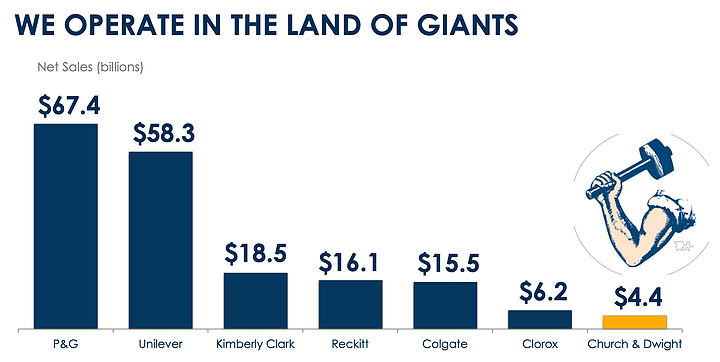
(Source: CHD investor presentation)
Most of CHD's sales are derived from its domestic business, representing 75.8% of total revenues in FY2020 up from 75.0% in FY2014. To the detriment of the Speciality Products Division ('SPD'), 'Consumer International' sales now contribute 17.4% to total revenues, up from 16.2% five years ago.
In terms profitability for each of CHD's business segments, Consumer Domestic enjoys the highest EBIT margin, which is now stabilizing at around 20%. Nonetheless, the company's overall EBIT margin has come down over the past years as its gross margin has since started to contract despite the positive contribution of productivity programs.
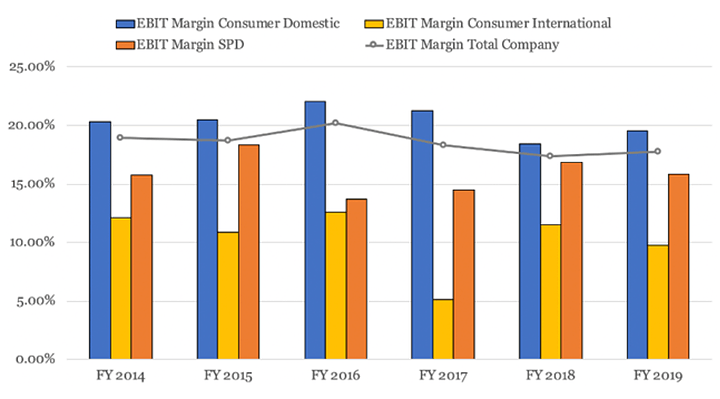
(Source: Author's work based on Church and Dwight reports)
Because of fierce competition in international regions, CHD achieves rather mediocre EBIT margins for its 'Consumer international' segment. This is more than offset by volume growth that twice the growth rate of its 'Consumer Domestic' (US), and robust pricing/product mix.

