
Summary
- Hershey stock has underperformed other food peers.
- This is logical, as Hershey didn't enjoy the same quarantine sales boost as rivals.
- However, the company's long-term outlook is fine, and at the present dividend yield, it's quite attractive.
- Looking for a helping hand in the market? Members of Ian's Insider Corner get exclusive ideas and guidance to navigate any climate. Get started today »
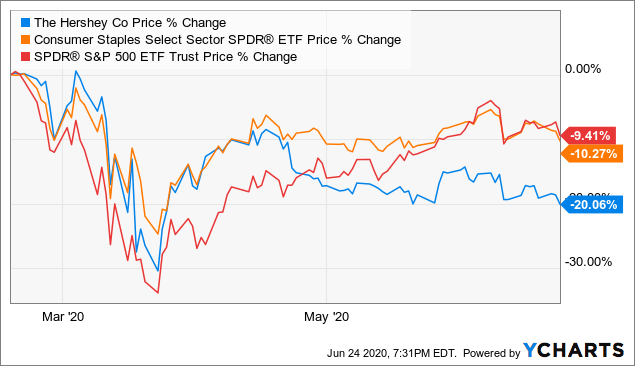
While the stock market keeps powering higher and higher in general, not all stocks are going up equally. In fact, many of the names that benefited from the eat-at-home trend during the virus have sold back off in recent weeks. Hershey (HSY) is right up there. Shares have dipped 13% since their April rebound level and are off more than 20% from the 52-week highs.
 Data by YCharts
As the chart shows, Hershey initially outperformed the broader market and stuck closer to its peers in the Consumer Staples ETF (XLP).
Since May, however, the S&P caught up to consumer staples, meanwhile Hershey diverged from both to the downside. As a result, Hershey is down 20% while both its sector and the broader market are only down 10%. This isn't a huge performance gap, but if you're looking to go shopping for high-quality stocks that you can buy and hold for decades, even a 10% or 20% price savings can make a huge difference on results.
Why Is Hershey Underperforming Lately?
Sometimes, it's complicated trying to parse out differing performance among peer companies within a sector. In this case, however, the explanation is simple: Hershey didn't benefit much from the stay-at-home demand surge. The company said as much in a business update last month:
"We continue to see declines in our food service, owned retail and world travel retail businesses as well as certain parts of our International businesses as a result of known shelter-in-place and other restrictions. We have also experienced a decrease in retail foot traffic and volatility in consumer shopping and consumption behavior across several areas of our portfolio, which has negatively impacted sales of our portable and on-the-go consumption products."
Chocolate is often an impulse buy. Consider where it is located at grocery store - right next to the check-out aisles, hoping you'll grab one on the way out. Chocolate is a high-margin business, and as such, grocers put it in prime position to drive marginal sales to weary shoppers.

