
Summary
- Rite Aid's recent de-levering efforts, as well as the various initiatives disclosed at its analyst day, are admittedly a step in the right direction.
- However, I am concerned the deleveraging target may prove too aggressive, especially considering the planned near-term capex ramp.
- The stock trades at an unwarranted premium to peers, offering little value at these levels.
While Rite Aid's (RAD) latest turnaround strategy was a step in the right direction, I would caution investors against turning bullish pending solid, demonstrated progress towards the new strategic vision. In addition, persistent industry challenges, for instance, reimbursement rate pressure, a challenging competitive environment, and shifting consumer preferences, along with a planned capex ramp over the next two years, raise concerns over the viability of the projected deleveraging path. With RAD's multiple currently a full turn above peers such as WBA, I see the current premium as unwarranted given its scale disadvantages and the elevated risks posed by its debt levels.
RAD Lays Out Long-Term Targets Expected to be Realized by FY23
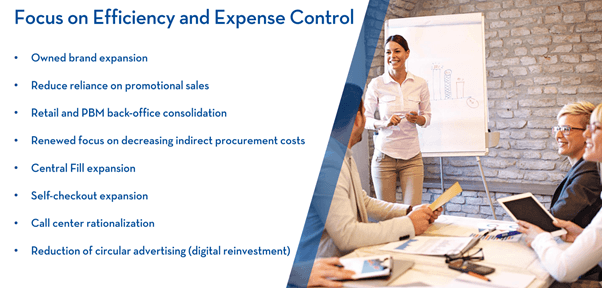
RAD's updated long-term targets call for a mid-single-digit increase in related prescription growth, low-single-digit growth in front-end revenue, and high-single to low-double-digit growth in PBM revenue. The priority remains on driving front-end and PBM margins, via a reduction in SG&A expenses. Most of the cost cuts will come through operational efficiencies (e.g., expansion of own brands, consolidation of back-office personnel, and call centers, among others), which are guided to precipitate $300 million in cumulative savings over the next three fiscal years.
Source: Investor Presentation
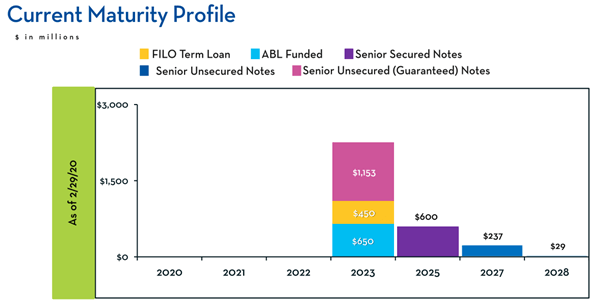
Management has also set a lofty deleveraging target, outlining a path to ~4.0x by FY23 from the current 5.3x. To achieve this, RAD is looking to accelerate its debt paydown - while RAD has no debt maturities due until FY23, it is willing to pre-pay debt over the next 12-18 months using proceeds from the monetization of ancillary stores and distribution centers (anticipated at ~$200-$300 million).
Thus far, RAD has tracked well on its deleveraging plans - $157 million of unsecured notes maturing in FY27 and FY28 were recently repurchased, while $600 million in 7.5% exchange notes were extended to FY25, and $450 million of asset-backed loans ((ABLs)) were paid off using proceeds from the sale of receivables. These deleveraging efforts have ultimately been favorable, unencumbering sufficient liquidity for RAD to manage its business comfortably over the upcoming 2-3 year transformational period.
Source: Investor Presentation
While the recent steps, as well as the updated deleveraging targets, are notable positives, I think management's openness to growth M&A at a time when debt paydown should be the priority, warrants caution.

