
Summary
- Dick's shares are trading at 8.1x TTM P/E and its dividend yield has been pushed up to 4.6%.
- The company just reported a solid 2019 fiscal year with same-store sales up 3.7% and gross margins up 29 basis points.
- Looking at a coverage ratio of lease and interest payments for Dick's, it came to only 1.80x in FY 2018 and has been slipping in recent years.
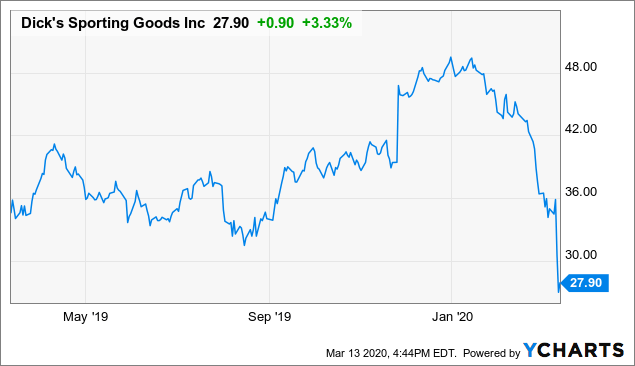
Dick's Sporting Goods (DKS) has seen its share price pummeled as fears around COVID-19 spread and sporting events have begun to be canceled. The recent bankruptcy of Modell's Sporting Goods added fuel to the fire sale and is a good reminder to potential investors of how a retail business can go under. All of this has now left Dick's shares trading at 8.1x TTM P/E and pushed its dividend yield up to 4.6% before considering share buybacks that have averaged 2% since 2007. This article will take a look at Dick's historic profitability and ability to return cash to shareholders, before ending off with an analysis of the company's current debt and interest coverage.
 Data by YCharts
Results Are Still Looking Good
Dick's fiscal year (FY) 2019 results were strong in my opinion when the company released on March 10, 2020. Unfortunately though, the strong results were quickly pushed aside along with the recent market turmoil. For Dick's FY 2019, the company reported same-store sales of 3.7%. On the EPS side, Dick's delivered 2019 earnings per diluted share of $3.34 with the non-GAAP figure being $3.69, up 3% and 14% respectively versus $3.24 in 2018, a year in which there were no non-GAAP adjustments. Also an important metric for retailers, the gross margin rate expanded 29 basis points to 29.19% in 2019 from 28.90% in 2018. That being said, DKS's flat to +2% guidance for FY 2020 same-store sales might have been cause for concern to some analysts, but, as long as I am not paying for growth in the valuation (such as with Dick's mere 8.1x P/E), I am perfectly fine with just a flat outlook.
DKS looks to have healthy liquidity with $69M in cash on the balance sheet, and only $224M outstanding on its $1.6B revolving credit facility. The company also took the year-end earnings release opportunity to announce an increase to its quarterly dividend by 13.6% to $0.3125 per share. Also on the shareholders' return front, throughout 2019, DKS repurchased approximately 11.1 million shares of its common stock at an average cost of $36.40 per share, for a total cost of $402.2M.

