
Summary
- Management expects loan growth to remain strong in 2020, partly due to opportunities arising out of a merger of two competitors.
- Net interest margin is expected to decline due to the Fed's rate cut. This will act as the biggest drag for earnings.
- Overall, earnings are expected to increase in 2020. However, quarterly dividends are likely to be maintained at the current level.
Earnings of Atlantic Union Bankshares Corporation (AUB) are expected to surge in 2020 due to organic loan growth. The increase in earnings should be constrained by lower net interest margin, and slightly higher non-interest expense. While there will be room for an increase in dividend, I'm expecting the company to maintain quarterly dividends at the current level.
Merger of Competitors to Provide Opportunity for Loan Growth
Due to seasonal factors, loan growth slowed in 3QFY19 as government contracting clients paid down their borrowings ahead of the federal government's September 30 fiscal year-end. Loan growth is expected to return to a normal level following the seasonality-led reduction.
As disclosed in the 3QFY19 conference call, the management expects loan growth rate of 6% for the full-year of 2019. For 2020, the management expects high single digit growth, in between 7% to 9%. According to the management, the BB&T and Sun-Trust merger will create opportunity for AUB to grow by capturing market.
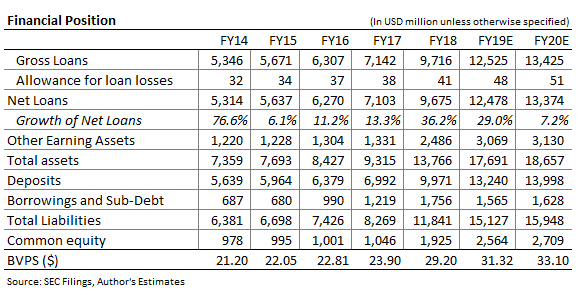
Given the above mentioned management guidance, I expect AUB's loans to grow by 1.75% quarter over quarter in 4QFY19, and by 7.2% year over year in 2020. The table below summarizes my estimates for key balance sheet items.
Provisions Charge to Remain High
AUB's credit quality is expected to remain strong as there are hardly any signs of systemic problems. Although there are signs of economic slowdown nationwide, the problems are not big enough to affect debt serviceability. Unemployment dipped to a low of 2.70% in Virginia, where AUB primarily operates, showing the resilience of the economy.

