
Summary
- The P/E ratio now at just 6 and change.
- The book multiple, however, is well over 14.
- We discuss whether the recent August bottom will end up being a hard low for the stock.
- Looking for a helping hand in the market? Members of Elevation Code get exclusive ideas and guidance to navigate any climate. Get started today »
The question for value investors is whether there is any value in Pitney Bowes Inc. (PBI) (Business Equipment Supplier) at present. Shares have been on a multi-year decline since 2014 as the pattern of lower highs and lower lows, unfortunately, has become the norm. Although the dividend has been cut in recent times, it still stands at 4.36% which is slightly above the average in this industry.
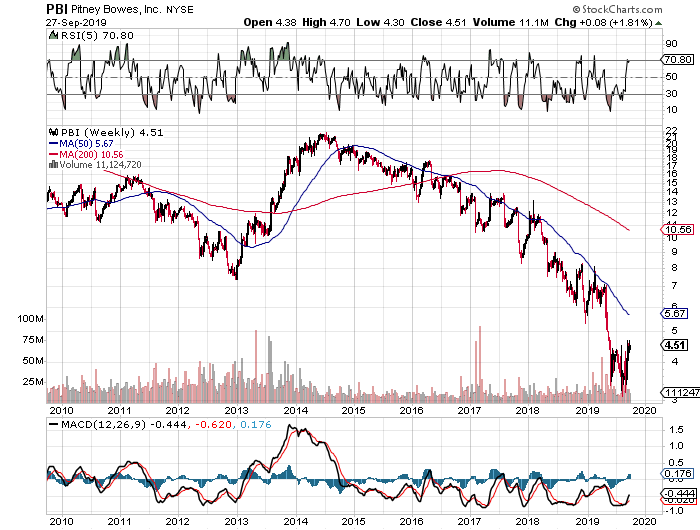
A metric which will also pique the interest of value investors is the firm's P/E ratio which stands at an ultra-low 6.6 at present. Therefore, despite the multi-year downturn shares have had to endure, we can see the firm is still profitable which obviously is a plus. Wall Street is driven by earnings and it has been demonstrated that companies with the highest P/E ratios usually fall the greatest.
However, there are a few drawbacks with a low P/E ratio which can often be overlooked. Yes, Pitney Bowes is profitable at present. The firm has earned over $300 million in operating profit over the past four quarters alone. However, this key metric is down over 15% on average per year over the past three years and the trend seems to be getting worse. Essentially, if Pitney Bowes's valuation is going to revert to somewhere close to its mean, the firm needs to grow its profits. If profits were to continue to deteriorate, for example, the investor runs the risk of investing in a value-trap here.
We state this because of the condition of the firm's balance sheet at present. Currently, there is only a mere $53 million of shareholder equity on the balance sheet as opposed to $5.7 billion of liabilities. The main liability at the firm is over $3 billion of long-term debt. Therefore, the debt to equity is almost 60 and again trending in an adverse way.
This brings us to the second problem or mistake with respect to investing in low P/E stocks. When one does not research the other valuation metrics, one does so at their peril. For example, the book multiple at present in Pitney Bowes is 14.52. We usually look for this number to be under one for our long-term value play stocks. A high book multiple means one is not getting a lot of assets for the corresponding investment. Why is this important?

