
Summary
- Thanks to its debt offering, a heavily dilutive equity issuance has become very unlikely.
- The upsized offering also highlights that debt markets are not seeing a large bankruptcy risk.
- The only remaining substantial threat is the opioid litigation, and things are looking much better recently.
- This idea was discussed in more depth with members of my private investing community, Stability & Opportunity. Get started today »
In my recent article "Opioids For All, But Not For Mr. Market", I expected the stock market to calm down soon and find a more rational perspective on Teva Pharmaceutical (TEVA). Since it was published, the stock has rallied 36%. So, is there more upside left?
Yesterday, Teva announced an upsized debt offering, i.e., demand for its debt was higher than expected, as instead of just $1.5 billion, a total amount of $2.1 billion was sold, of which ~$1.1 billion was in euro. All notes mature in 2025, and the euro-denominated notes carry a very convenient interest rate of 6%, while the USD-denominated debt carries a 7.125% interest rate. The difference is lower than the ~2.3% spread between U.S. and Euro LIBOR rates, so from this point of view, the USD debt is actually more convenient than it seems.
With the money raised, Teva will retire debt due in 2021 and 2020, indicating that it wants to get near-term obligations out of its way. The next significant refinancing will need to occur before 2023, when over $4 billion of notes come due.
I assume the new notes are callable just as the ones Teva will redeem with the proceeds, i.e., the company could lower its financing costs as soon as more favorable conditions become available.
Until 2023, Teva will only have to pay back $6.3 billion worth of debt, i.e., an average of $2.1 billion per year, which it will probably be able to fund with its free cash flow. (It projects $1.7-2 billion of FCF for 2019 and growth for the next few years.)
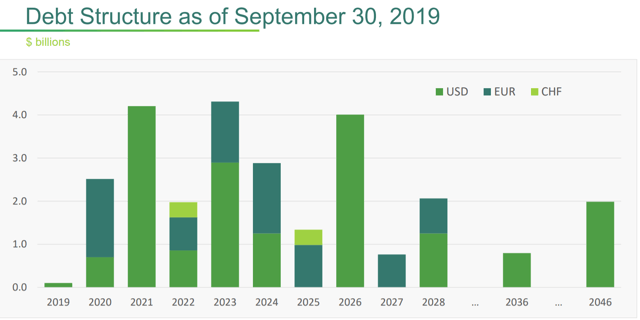
(Source)
On the other hand, interest obligations will increase due to this offering, as the replaced notes carried an average interest rate below 3% for sure (the exact mix was not disclosed). I would pencil in a hit to the income statement of ~$85 million per year. That said, the increased financial flexibility removes the threat of an equity offering and highlights once again that the usually quite efficient debt markets don't consider a bankruptcy as a likely outcome of the opioid litigations.

