
Summary
- Pfizer is one of the largest pharmaceutical companies in an industry where size brings financial stability and the pockets to make blockbuster acquisitions.
- The company's acquisition of Array BioPharma adds R&D potential to an already strong pipeline that should see multiple blockbusters come to market over the next several years.
- Despite shares ascending to above $40, years of range-bound trading have resulted in the stock remaining attractively valued.
The pharmaceutical industry can be full of risky investment choices because often times, a company's fortunes hinge on a break-out or blockbuster type of product coming to market. Once such a product hits, it produces years of (often non-contended) cash flow due to the current structure of our patent systems. We have always found that the best way to find stability in this industry - that is consistent (but not always the most explosive) growth - is to find these pharmaceuticals with large, existing cash flow streams. These companies have already hit on their "breakout" product, but being flush with cash allows them to keep swinging for new breakthroughs or buy emerging companies in order to sustain success. Pfizer Inc. (PFE) has stagnated over the years due to expiring patents on some legacy products. However the company's strong cash flow streams have enabled it to retool for future growth. With the stock at a reasonable valuation, we like Pfizer as a safe and solid play within a volatile sector.
Financial Strength Brings Stability
Pfizer is one of the world's largest pharmaceutical companies with a market cap of $237 billion. The company offers a diverse portfolio of both prescription and consumer products. The pharmaceutical business can be very financially volatile for companies. The reason being that these drugs are very expensive to research and develop. Along the process from conception to approval, there are various stages and trials along the way where drugs can fizzle out and die. This means that millions can be spent, only for a product to fail before reaching the end of the approval process.
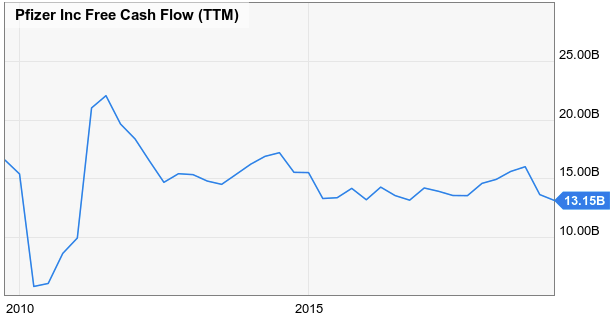
The upside of this business is that once approved for market, these drugs have patent protection. These drugs create years of recurring revenues for the drug companies. So in this industry, size is a huge tool for a company to survive and thrive. A stable of multiple products gives a pharmaceutical company a lot of financial resources. Pfizer's cash flows have hovered in the $13-15 billion range annually for years because of a strong portfolio of approved products. In 2018, 10 products (either direct of via partnership) generated more than one billion in revenue.
 Source: YCharts
These cash flow streams are used to distribute cash to shareholders in the form of dividends and buybacks, as well as manage the company's large balance sheet and help fund M&A ventures.
For example, Pfizer has aggressively repurchased shares over time and, as a result, the number of outstanding shares has fallen from 8 billion to 5.5 billion. Additionally, investors have seen the dividend payout grow at a CAGR of 7.2% over the past five years. The dividend's current yield of 3.36% is a solid yield that gives investors an income stream in addition to potential capital gains.

